

Universal Logistics Application (ULA)
December 2, 2020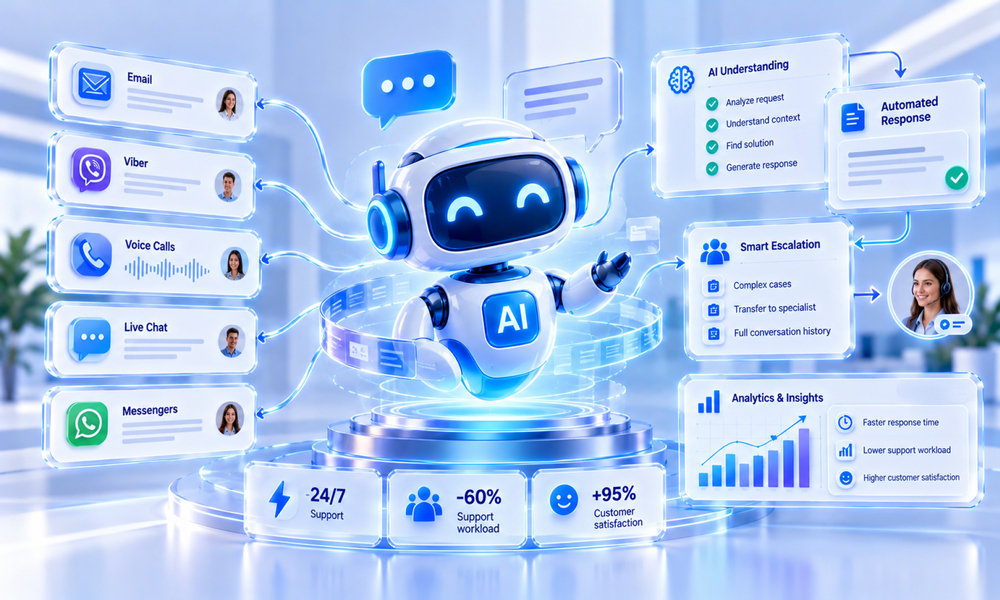
The company needed a solution that could automate repetitive inquiries while maintaining a consistent standard of communication across all customer touchpoints.
The key objectives were to:
- Automate customer support across email, messaging, and phone channels.
- Understand the context and intent behind customer inquiries.
- Reduce response times and waiting periods.
- Minimize the workload associated with repetitive support tasks.
- Identify complex, sensitive, or potentially conflicting situations.
- Escalate inquiries that require human intervention.
- Maintain interaction histories and generate operational reports.
- Monitor service quality and technical performance.
One AI assistant. Multiple communication channels. A consistent customer experience.
Discover how an omnichannel AI assistant can automate routine customer inquiries across email, Viber, and phone calls, reduce the workload on support teams, and ensure that complex cases are handled by the right people.
Client:
The client handles a high volume of customer inquiries related to parts intake, current pricing, product shipping, and payments.
Customers contact the company through multiple channels, including email, Viber, and phone calls. Managing these interactions consistently while ensuring timely responses created an opportunity to improve customer service through AI-powered automation.
The Solution: One AI Assistant Across All Channels
We implemented an omnichannel AI assistant built around the principle of one intelligent core connecting multiple communication channels.
The solution integrates Gmail, Viber, and telephony into a unified customer service workflow. Each channel follows consistent communication logic, allowing the company to automate routine interactions while maintaining control over more complex situations.
Email Automation
The AI assistant monitors incoming emails, evaluates their content, and determines whether an inquiry falls within the approved scope of customer support.
It generates relevant responses and sends them automatically, helping the company handle recurring questions about pricing, parts intake, shipping, and payments more efficiently.
AI-Powered Support in Viber
Through Viber, the assistant processes incoming text messages and maintains conversations within the company's defined area of expertise.
It uses conversational context to provide relevant responses and can identify the basic context of customer-submitted images. When a request falls outside the supported topics, the assistant guides the conversation back to relevant services and information.
Real-Time Voice AI Assistant
The most distinctive feature of the solution is its voice AI assistant, which communicates with customers naturally during live phone calls.
The assistant answers incoming calls, recognizes speech, interprets customer requests, and provides relevant information in real time.
Unlike a traditional interactive voice response system based on predefined menus, the assistant enables customers to explain their needs in their own words and receive contextual responses during the conversation.
The system can handle concurrent incoming calls. When a request is too complex, cannot be reliably interpreted, or requires a decision from a responsible employee, it is recorded for further handling.
Phone calls are also recorded to support service quality monitoring.
This approach extends automation to telephone support, helping businesses manage customer inquiries more efficiently without relying exclusively on human operators for routine conversations.
Intelligent Escalation of Complex Customer Inquiries
Effective customer service automation is not about eliminating human involvement. It is about recognizing when human expertise is needed.
The AI assistant identifies situations that require additional attention, including:
- Aggressive or confrontational communication.
- Threats and other critical situations.
- Explicit requests to speak with a human representative.
- Inquiries that cannot be resolved reliably through automated responses.
These cases are recorded in a dedicated database and classified according to priority levels, helping the team distinguish between issues that can be handled during the working day and situations requiring immediate attention.
Each record can include the communication channel, customer contact details, date and time, conversation history, reason for escalation, priority level, customer sentiment, a summary of the issue, and a recommended next step.
Instead of receiving an isolated alert, employees get structured information that helps them understand the situation and continue the conversation without starting from scratch.
Analytics, Reporting, and System Monitoring
The solution includes reporting and technical monitoring to support ongoing service quality and operational control.
Weekly reports provide an overview of customer service activity, including the volume of processed inquiries, the share of successfully resolved requests, and negative or problematic cases.
Call recordings, histories of escalated inquiries, and technical logs for individual communication channels are maintained separately.
Error monitoring and system alerts help the team identify technical issues and respond to potential disruptions, supporting the stability and reliability of the service.
Business Benefits
Reduced Workload for Support Teams
The AI assistant takes care of repetitive consultations, allowing employees to focus on complex cases, sales activities, and situations that require individual attention.Greater Visibility and Control
Reports, call recordings, interaction histories, and technical logs provide management with a clearer view of service performance and opportunities for improvement.Faster Customer Responses
Customers receive relevant information through their preferred communication channel without unnecessary waiting for an available employee when their inquiry can be handled automatically.Consistent Communication Across Channels
A shared approach to email, messaging, and phone interactions helps maintain consistent information and a unified standard of customer service.Better Handling of Complex Cases
Sensitive and non-standard inquiries are identified, documented, and escalated with the context needed for effective follow-up.Scalable Customer Support
Automation helps the business manage growing volumes of customer communication without requiring a proportional increase in support staff.
The Result
The client gained an integrated AI-powered customer service solution connecting email, Viber, and telephony within a unified workflow.
The assistant automates routine consultations, supports natural voice conversations in real time, identifies problematic inquiries, and ensures that cases requiring human attention are documented for follow-up. Reporting and technical monitoring provide additional visibility into the quality and reliability of the service.
The result is a more responsive and manageable customer service operation, with less time spent on repetitive inquiries and more capacity to focus on customers who need personal assistance.
Could an AI Assistant Work for Your Business?
If your team spends too much time answering the same questions, switching between communication channels, or handling routine phone calls, an AI assistant could help you streamline these processes.
Imagine a solution that responds to customers across email, messaging apps, and phone calls, while keeping your team informed and ready to step in whenever human expertise is needed.
Could your business benefit from an AI assistant like this?
Let's discuss your customer service processes and explore how AI automation could work for your company.